
Review · CHICAGO
Chicago Architecture Center River Cruise aboard First Lady
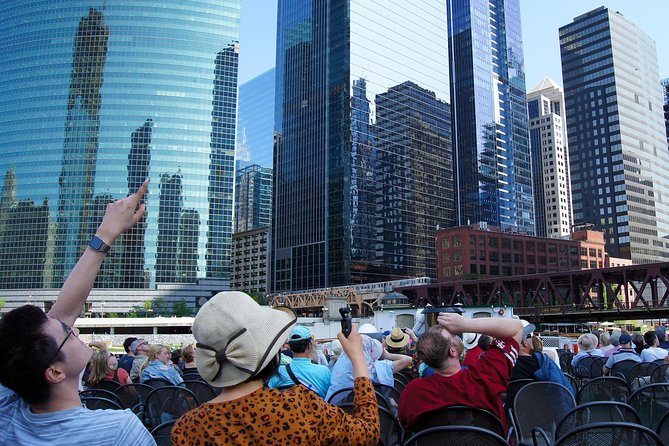
Chicago’s best architecture tour is viewed from the water, where the buildings rise straight from the river and compete for your attention. On this 90-minute cruise aboard Chicago’s First Lady, a Chicago Architecture Center docent connects the skyscrapers to the city’s bridges, industry, politics, and changing neighborhoods. I like the clear storytelling and the chance to see a wide slice of downtown without walking miles. I also like the heated lower salon, a useful refuge when the river wind turns sharp. The main drawback is fixed seating by arrival order, so a late arrival can limit your view.
This cruise is especially useful near the start of a Chicago visit. You get a quick map of the city’s architecture, then recognize buildings and design ideas as you explore on foot. The $57 price is not bargain sightseeing, but it is fair for a 90-minute cruise with a trained docent, restroom, indoor seating, and a full bar. Dress for changing weather, and arrive 30 minutes early.
What makes this Chicago river cruise worth your time
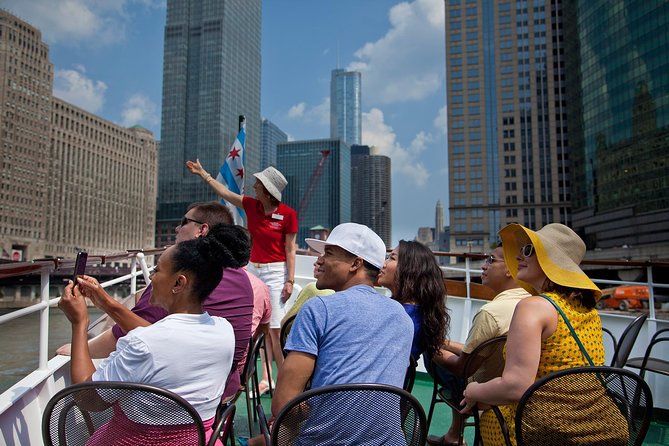
- Chicago’s skyline from the river: See buildings from angles that sidewalks cannot provide, including Marina City, Willis Tower, and 150 North Riverside.
- A real architecture docent: Guides such as Cynthia, Laura, Amy, Mark, Russell, and Nick have led engaging departures, though your guide will vary.
- A useful first-day orientation: The route links architecture with the river, bridges, business, industry, and urban change.
- Open-air or climate-controlled seating: The upper deck gives you the best outdoor view, while the lower salon helps on cold or rainy days.
- A full 90 minutes without a walking marathon: You cover a large part of central Chicago while staying aboard the boat.
- Convenient downtown location: The dock is at 112 E Wacker Drive, close to Millennium Park and the Magnificent Mile.
Why seeing Chicago from the river changes the city
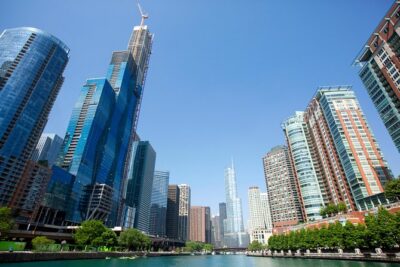
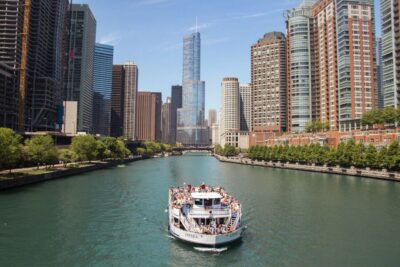
From the street, Chicago’s buildings can feel like isolated objects. From the river, they form a sequence. You see how a tower meets the water, how one building frames another, and how the river cuts through the center of the city like a moving history lesson.
The Chicago River also gives the cruise its subject beyond architecture. It has served industry, transportation, shipping, recreation, and urban renewal. As the boat moves through the downtown corridor, your guide explains how the river changed along with the city. That context keeps the trip from becoming a simple parade of tall buildings.
I particularly like this format for a short visit. You do not need to study a map or plan a route through several neighborhoods. For 90 minutes, you can sit back while the guide points out major buildings and explains why they matter. Then you can return to the streets with a better sense of direction.
The commentary is the heart of the experience. The best guides, including Cynthia, Laura, Amy, Mark, Russell, and Nick on different departures, bring personal energy to the material. Expect the guide to explain architectural ideas in plain language rather than recite dates and names. The strongest moments come when the guide explains how nearby buildings relate to one another.
More River Cruises in Chicago:
- Chicago Architecture River Cruise
★ 5.0 · 15,756 reviews - Chicago River: 1.5-Hour Guided Architecture Cruise
★ 4.8 · 8,046 reviews - Chicago: Architecture River Cruise Skip-the-Ticket Line
★ 4.8 · 4,325 reviews
Boarding at 112 E Wacker Drive
The cruise begins at the Chicago Riverwalk dock at 112 E Wacker Drive. The entrance is at street level near the northeast corner of Michigan Avenue and Wacker Drive, about three blocks north of Millennium Park and close to the Magnificent Mile.
Give yourself at least 30 minutes before departure. You need time to find the Riverwalk entrance, reach the dock, and board. Summer crowds can slow things down. One practical wrinkle is that seating is general admission, even though seat numbers may appear on tickets. Ignore those numbers and choose your place after boarding.
There is no elevator access to the boat dock, so plan for stairs. This matters if you have mobility concerns or are managing bulky items. Luggage cannot come aboard, and there is no dockside storage, so leave suitcases at your hotel.
The nearby LAZ parking garage at 111 E Wacker Drive is directly across from the stairway to the dock and next to the Chicago Architecture Center. Parking costs extra. Public transportation is nearby, making the cruise easier to reach without a car.
If your booking arrives on your phone through a ticket agent, allow extra time at the ticket office. A phone confirmation may not be the final boarding ticket, and the exchange process can create unnecessary stress when departure time is close. Arriving early solves most of that problem.
The Chicago River sets the lesson in motion
Once aboard, the boat heads into the Chicago River for its central 90-minute route. The exact vessel, schedule, and route can change without notice, but the tour focuses on the major architectural corridor through downtown.
The river is not just a scenic channel. Its uses have shifted over time, from industry and transportation to recreation and tourism. The guide uses that change to explain why Chicago developed the way it did. You learn to look at the river as part of the city’s design, not merely as a place where boats pass.
Keep your eyes moving. Buildings appear quickly, and the best angle can last only a short time as the boat passes beneath bridges and around bends. The upper deck is usually the natural choice for photographers, but the lower salon has large windows and keeps you out of the weather.
Navy Pier and the value of adaptive reuse
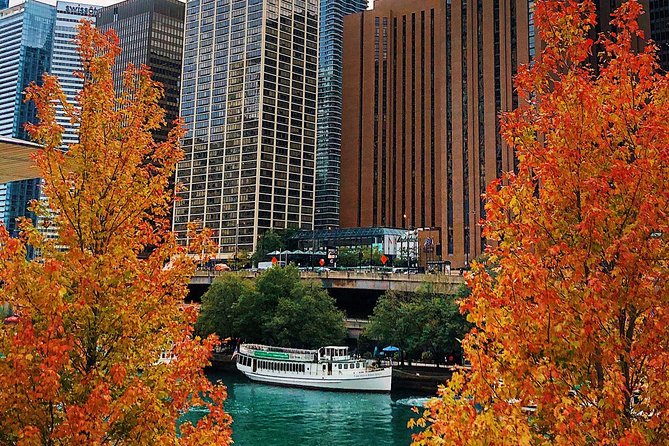
Navy Pier appears as a reminder that city landmarks can change jobs without losing their identity. It has served as a naval base, university campus, shipping center, and entertainment destination.
From the boat, the pier helps explain Chicago’s connection to the lake and river. It is also a useful example of adaptive reuse, the process of giving an old structure a new purpose. You will not spend time walking through Navy Pier on this cruise, but seeing it from the water places it within the city’s larger story.
This is one reason the boat works so well. You are not stopping at every landmark, so the route can cover more ground. The tradeoff is that you get a view and explanation, not an interior visit or a long photo stop.
A few more days afloat around Chicago worth a look
- Chicago: 45-Minute Family-Friendly Architecture River Cruise
★ 4.7 · 2,304 reviews - Chicago: 1.5-Hour Lake and River Architecture Cruise
★ 4.7 · 2,050 reviews - Chicago by Night River and Lake Cruise
★ 4.6 · 791 reviews - Chicago: Shoreline Lake Michigan Skyline Cruise
★ 4.6 · 758 reviews
Marina City and Chicago’s vertical experiment
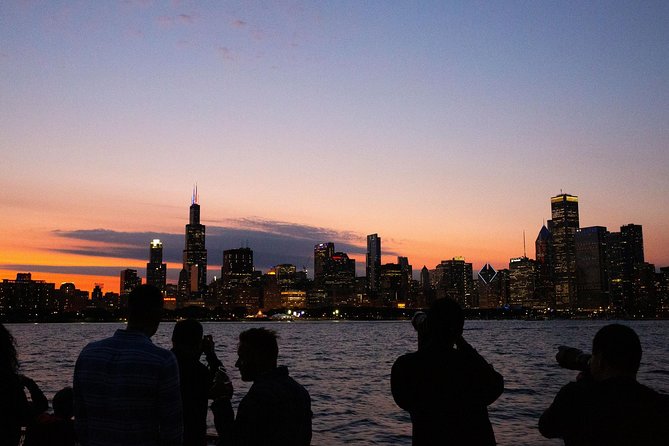
Marina City is one of the cruise’s most memorable sights. Bertrand Goldberg designed the twin cylindrical towers as an urban experiment meant to bring middle-class residents back to the city during a period of suburban migration.
Their shape is easy to recognize from the water. The towers do not simply rise as flat slabs. Their curved forms and stacked balconies create a very different rhythm from the rectangular office buildings nearby. The guide uses Marina City to discuss housing, city life, and the effort to keep people living downtown.
I like this stop because it shows that Chicago architecture is not only about height. It is also about solving social and urban problems. You see a bold design, then learn the reason it was built.
Trump International Hotel and Tower in context
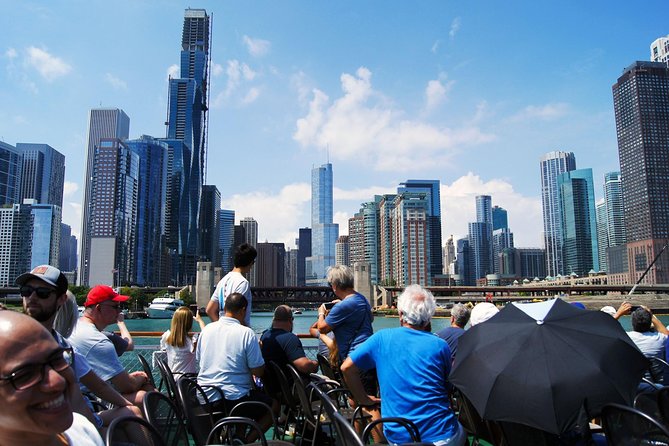
The Trump International Hotel & Tower provides a lesson in how new buildings respond to older surroundings. Its glass and steel exterior reflect the river and neighboring structures, so the guide can discuss the relationship between a tower and the city around it.
The useful point here is not simply the building’s name. It is the way the tower joins a riverfront group of structures from different periods. From the boat, you can compare materials, height, shape, and placement without stopping at a busy sidewalk.
The guide may also use this building to explain how a modern tower has to fit into an established downtown setting. That makes the view more interesting than a simple list of famous addresses.
Mies van der Rohe and the discipline of modernism
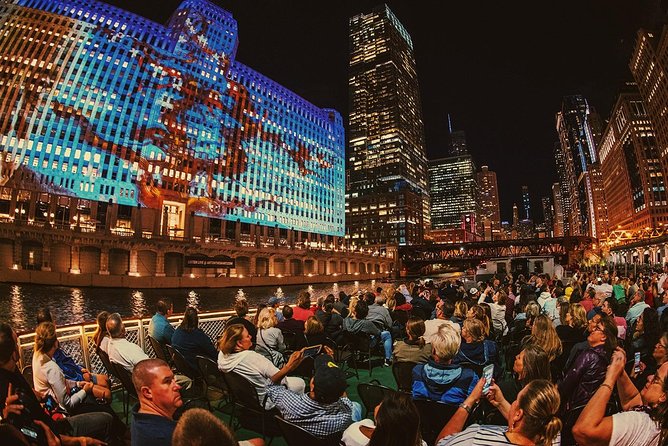
One of the last American projects designed by Ludwig Mies van der Rohe occupies a prominent place along the Chicago River. Mies is central to the story of modern architecture in Chicago, and this building gives the guide a chance to explain his restrained approach.
Look for strong lines, carefully controlled materials, and a sense of order. The structure does not need elaborate decoration to make an impression. From the water, you can judge its proportions against the river and nearby towers.
This part of the cruise will appeal to you if you enjoy design details. If you mainly want dramatic skyscraper views, the building may feel quieter than Marina City or Willis Tower. The guide’s explanation is what makes it memorable.
150 North Riverside and the engineering show
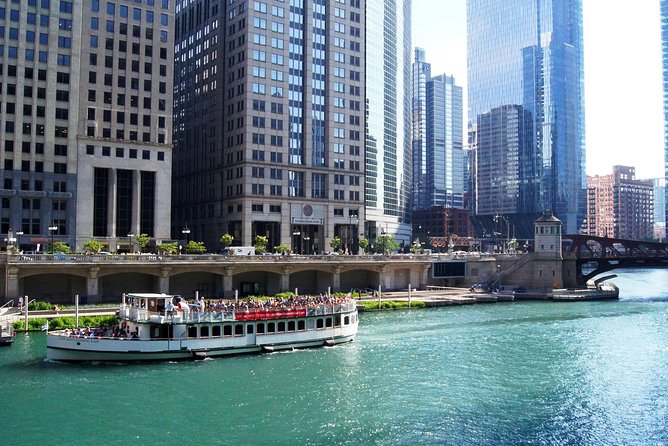
150 North Riverside is among the route’s most eye-catching modern buildings. Its narrow base and broad upper section create the impression that the tower is balancing above the ground.
The unusual form is not just a visual trick. The building’s design sends your attention downward to its support system and surrounding open space. From the river, the structure reads clearly because you have room to see its full height.
The cruise also passes Boeing International Headquarters at 100 N Riverside Plaza. These buildings help broaden the tour beyond the familiar landmarks. You get a look at newer Chicago architecture and hear how engineering decisions shape the skyline.
Willis Tower and the scale of Chicago
For almost 25 years after its completion, Willis Tower, formerly the Sears Tower, was the tallest building in the world. From the river, its height is easier to grasp because the surrounding canyon gives you a strong vertical reference.
The guide places the tower within Chicago’s competition to build higher and create more efficient office space. You also get a useful reminder that the skyline is not frozen in time. A building can lose the world’s tallest title and remain one of the city’s defining sights.
Do not expect to visit the Skydeck on this cruise. The attraction is the exterior view and the explanation from the water. If you want to go inside Willis Tower, plan that separately.
The former Marshall Field’s warehouse
Size has long mattered in the Midwest. Completed in 1930, the former Marshall Field’s wholesale warehouse was the largest building in the world at the time. Retailers used it to buy stock, giving the structure a practical role in Chicago’s commercial system.
This stop adds an industrial and business angle to the tour. Not every important building was designed as a glamorous office tower. Some were built to move goods, support retail, and handle the machinery of commerce.
That variety is one of the cruise’s strengths. Within 90 minutes, you see residential towers, corporate buildings, engineering experiments, warehouses, and entertainment spaces. The city’s architecture becomes a record of changing needs.
The Chicago Mercantile Exchange and the Freedom Center
The route also passes the Chicago Mercantile Exchange Building at 20 S Wacker Drive. Its presence lets the guide connect the physical skyline with Chicago’s role in finance and business.
The Chicago Tribune Freedom Center provides another point of contrast. From the boat, these buildings become part of a larger sequence rather than isolated stops. You learn how news, commerce, offices, and transportation all share the river corridor.
The itinerary moves quickly, so listen closely when the guide introduces a building. If you are trying to photograph every structure, you may miss part of the explanation. I recommend taking a few broad skyline pictures, then putting the camera down for the guide’s main points.
What the boat is like in changing weather
The cruise runs in all weather. That is helpful for planning, but it means you should dress for the conditions rather than count on a perfect day.
The upper deck is open air and offers the most direct views. Sun can interfere with photographs and make it harder to see the buildings, so bring sunglasses, a cap, or a visor. In cold weather, shade along the river can make the boat feel colder than the temperature suggests.
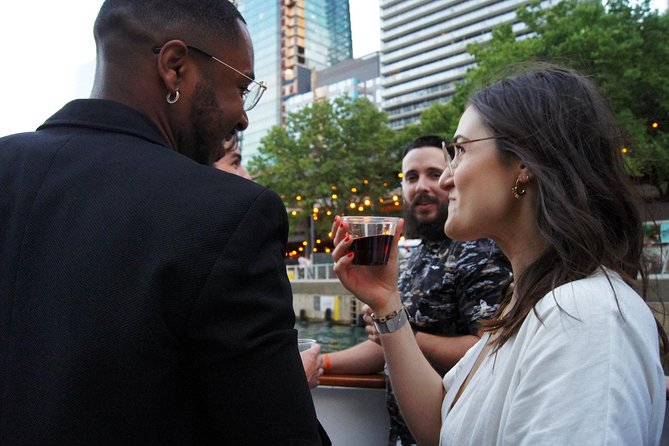
The lower level is enclosed and climate controlled, with large windows. It is not a poor-weather consolation prize. You can still see the architecture while staying warm or dry. The heated area has been especially welcome on chilly departures, and the onboard bar offers drinks such as hot chocolate, beer, and other refreshments.
There is a restroom on board. For safety, restrooms close 15 minutes before the tour ends. Food and light snacks are available for purchase, but they are not included in the ticket.
Pets are not allowed, though service animals are permitted. Strollers can come aboard, but children must be removed during boarding. The stroller is folded and stored in the salon during the cruise.
The $57 question: is the cruise good value?
At $57 per person, this is more expensive than a basic sightseeing ride. You are paying for a focused architecture lesson, a trained docent, the boat ride, indoor and outdoor seating, and a downtown route that would take much longer to cover on foot.
I consider it good value if architecture, city history, or urban design interests you. It is also a smart choice for a short Chicago visit, because the cruise gives you a broad orientation in a compact 90-minute block.
The value is weaker if you only want a casual boat ride with little commentary. The guide is central to the experience, and the tour is built around explanation. You also need to accept general-admission seating, weather exposure, and a no-refund policy if your plans change.
A maximum of 250 people means the boat can feel active rather than intimate. The vessel is described as spacious and comfortable, but do not expect a private tour. Arriving early improves your choice of seat and lets you settle before the commentary begins.
Who should book the First Lady cruise?
I would choose this cruise for first-time visitors, architecture fans, photographers, and anyone who wants a fast introduction to downtown Chicago. It also works well for couples or friends who want a scenic break from walking.
Families can participate, but the experience is not recommended for children younger than 12. Younger children may enjoy the boat itself, yet the detailed architecture commentary requires patience. All children must be accompanied by an adult.
The tour is offered in English, and the quality depends in part on how well you connect with the guide’s presentation style. The named docents associated with recent departures, including Laura, Amy, Mark, Russell, Nick, and Cynthia, have each brought a clear and lively approach. Your guide may be someone else.
My booking advice
Book this near the beginning of your Chicago stay if you can. The cruise gives you a useful mental map, and later you can connect the buildings to what you heard on the river.
Arrive 30 minutes early, leave luggage at your hotel, wear layers, and decide whether an open-air view or a warm window seat matters more to you. If you want the best choice of general-admission seating, do not cut arrival time close.
I would book it if you want substance with your sightseeing and appreciate having a guide explain why the skyline looks the way it does. I would skip it only if you dislike scheduled tours, need guaranteed seating, or want to explore interiors rather than view buildings from outside. For most visitors with 90 minutes to spare, the mix of river views, design, and city history makes this one of Chicago’s strongest introductions.
FAQ
Where does the Chicago Architecture Center River Cruise depart?
The cruise departs from the Chicago Riverwalk at 112 E Wacker Drive. The entrance is near the northeast corner of Michigan Avenue and Wacker Drive.
How early should I arrive?
Arrive 30 minutes before departure. Allow extra time during summer, when the downtown area may be busier.
How long does the cruise last?
The cruise lasts approximately 1 hour and 30 minutes.
Is seating assigned?
No. Seating is general admission and boarding is first come, first served. Any seat numbers printed on your ticket are not valid.
What happens if it rains?
The cruise operates in all weather. The upper deck is open air, while the lower salon is enclosed and climate controlled with large windows.
Are drinks and snacks available?
Yes. Drinks and light snacks are available for purchase, and the boat has a full bar. They are not included in the ticket price.
Is there a restroom on the boat?
Yes. Restrooms are available, but they close 15 minutes before the tour ends.
Can I bring luggage?
No. Luggage is not allowed on board, and there is no dockside luggage storage.
Can I bring a stroller?
Yes. Children must be removed from strollers during boarding. Strollers are folded and stored in the salon during the cruise.
Is the cruise accessible by elevator?
There is no elevator access to the boat dock. The cruise is near public transportation, and most people can participate, but you should consider the dock stairs before booking.
Just added around Chicago
- City Cruises Chicago: 75-min Speedboat Architecture Cruise★ 4.5 · 268 reviews
- City Cruises Chicago: Seadog Lakefront Speedboat Ride★ 4.4 · 642 reviews
- City Cruises Chicago: Premier Lunch or Dinner Cruise★ 4.3 · 334 reviews
- Chicago: Narrated Sightseeing River and Lake Cruise★ 4.7 · 268 reviews
- Chicago: Shoreline Lake Michigan Skyline Cruise★ 4.6 · 758 reviews
- Chicago: Architecture Boat Tour with Drinks★ 4.7 · 466 reviews
- Chicago: Fireworks Cruise with Lake or River Viewing Options★ 4.3 · 551 reviews
- Chicago: Architecture Center Cruise on Chicago’s First Lady★ 4.7 · 456 reviews
Chicago Boat Tours, compared.
Chicago River: 1.5-Hour Guided Architecture Cruise
Read our review →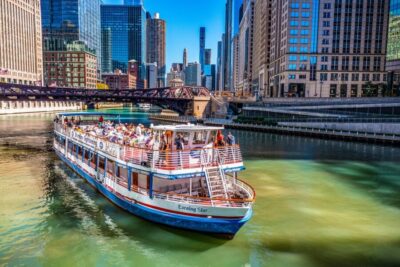
Architecture River Cruise Skip-the-Ticket Line
Read our review →
45-Minute Family-Friendly Architecture River Cruise
Read our review →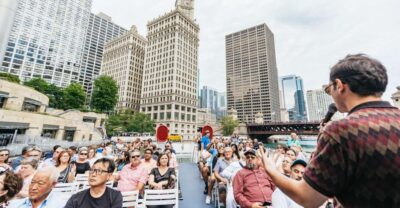
Browse the lists this tour appears in